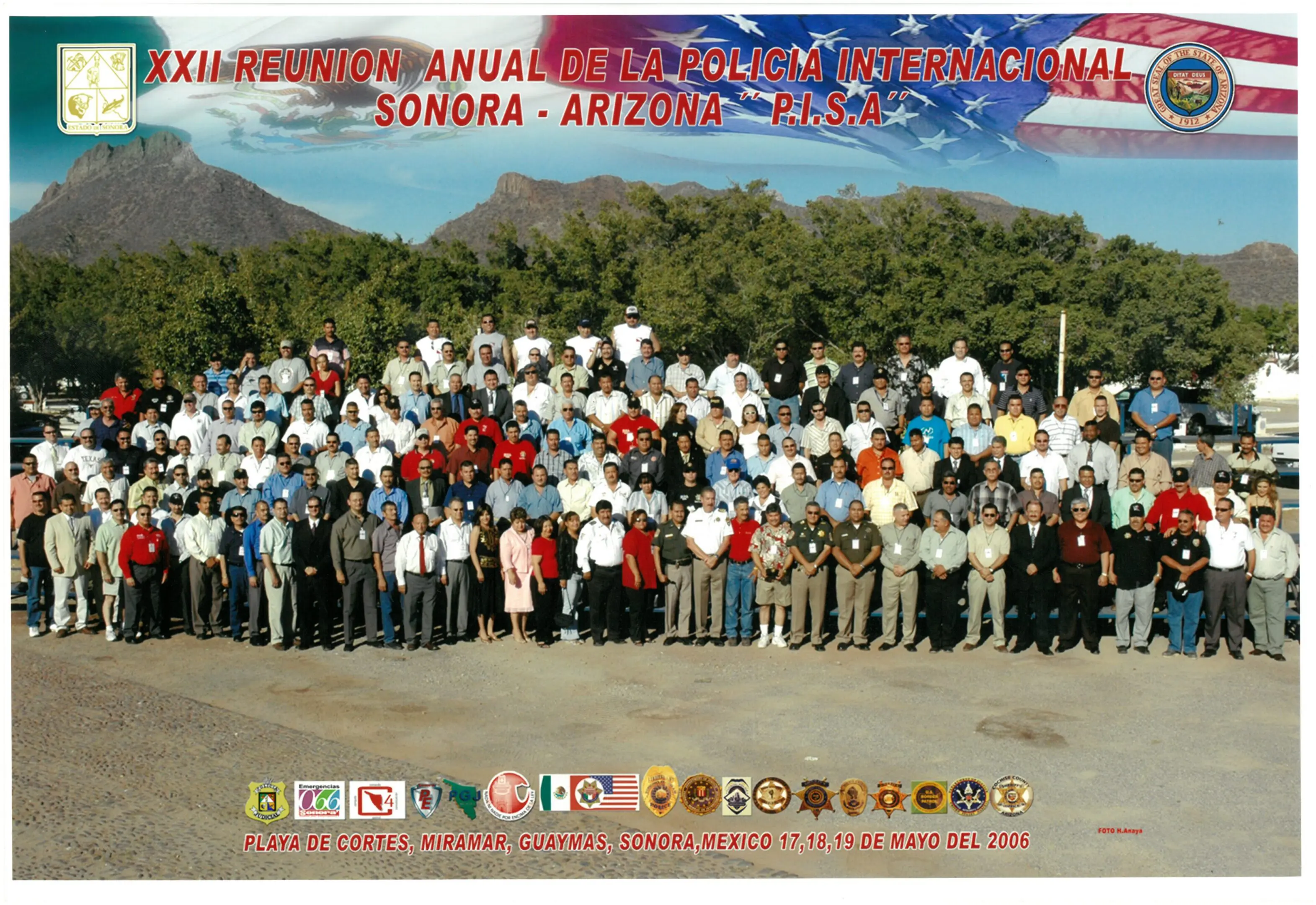
In early 1978, Douglas detective Frank Cruz and three Arizona task force officers, Bill Breen, Hector Carpio, and Jim Wilson, and two commandantes from the Sonora State Police met in Douglas, AZ, for an informal meeting. It was at this gathering that the group of six decided to call this meeting/reunion PISA, Policia Internacional Sonora-Arizona.
From the initial meeting of the six officers, PISA meetings have continued to foster better communications between the law enforcement agencies on both sides of the border in their daily fight to combat criminal activity. The success and effectiveness of such a meeting have caused the evolution of the membership to expand to several agencies from other states on both sides of the border. Since 1978, attendance at reunions has increased from the original few to almost five hundred persons representing all levels of government, including the Mexican State Department and U.S. law enforcement. As PISA continued to be a valuable source of information, training was offered to members to further explain the operation of the criminal justice systems in both the United States and Mexico. Increased cooperation with cross-border counterparts has been evident in numerous other situations, but especially in the recovery of stolen vehicles from Mexico. The Arizona Department of Public Safety reports an increase from a few hundred recoveries a year, some twenty years ago, to recovering an average of a thousand vehicles a year now. Since the adoption of the NAFTA Treaty, highway safety for commercial vehicles has become critical and is a mutual concern for both the U.S. and Mexico. Again, working with the Arizona Department of Public Safety, PISA has fostered cooperation that has enabled DPS to provide educational seminars to Mexican carriers. DPS continues to provide the standard eighty-hour CVSA (Commercial Vehicle Safety Alliance) courses, which have certified over 100 Mexican Federal Highway Patrol officers and thirty Federal Transportation Inspectors as inspectors in the Federal Motor Carrier Rules and Regulations. This ongoing project has now expanded to Sonora and Sinaloa. The successes coming from the networking of the PISA reunions are extremely valuable, including the initiation of several new programs that increase the assistance and cooperation of the Mexican authorities. In 1988, the Federal Bureau of Investigation started a program called MALLET (Mexican American Liaison-Law Enforcement Training) seminars. Each year, the FBI hosts five of these MALLET seminars for Mexican officers in various locations throughout the border states. An additional program with much success has been the Mexico Investigative Liaison (MIL) Teams in Arizona, developed by the U.S. Marshals Service, with deputies assigned to locate and coordinate the apprehension of fugitives in Mexico. One of the most important areas of cooperation arising from the reunion of PISA is the actual saving of the lives of individuals lost in the deserts. Banding together and sharing intelligence, the PISA member agencies have rescued many Mexican nationals lost in the deserts of Arizona.